![[personal profile]](https://www.dreamwidth.org/img/silk/identity/user.png) brandyn
brandyn"America shoulda been great! We shoulda been the envy of the world! Everybody was gonna sing and hold hands! An' these lizards made us look like a GODDAMN JOKE!" - Godzilla (2025) #1
Earlier last year Comic Company IDW, who had held the Godzilla comic license since 2011 had decided that for the first time since 2015 to create a shared universe for the Big G again. Long ongoing comics all set in the same continuity instead of a bunch of one shots and mini-series. There are three books in this new line, titled The Kai-Sei Universe, so far. However for the purpose of this I will only be talking about the flagship book of the line, just titled Godzilla. However first I think retracing the origin of the Godzilla concept and it's cultural impact is important whenever talking about the franchise.
The year was 1954, just 9 years after America dropped the atomic bomb on Hiroshima and Nagasaki. A cruel and unforgivable war crime, regardless of how America did and continues to dress up it's evil as necessary. Movie studio Toho was in negotiations with an Indonesian film company to create a movie together, a negotiation which would fall apart. It would stand to reason that part of why this happened is because of tensions between the two nations due to Japan's own horrific actions in World War 2, an evil it also ignores, but I digress. The producer of that never to be made film let his mind wander on the trip back home, inspired partially by the Castle Bravo test that America did. The Castle Bravo test being a nuclear test that ended up with more yield than they expected, radiating outside of the safe perimeter they had established and ended up radiating a japanese fishing boat, the Lucky Dragon No. 5. He ended up thinking about what larger horrors a weapon like the nuclear bomb could create. The first seeds of the King of the Monsters had been established, now it needed someone to help it take shape.
Enter Ishiro Honda. A man who through being repeatedly drafted and recalled was on the frontlines for basically all 6 years of World War 2. To be transparent I was going to go into some specifics of his time in the military but truly it’s not necessary and his life is so interesting that it’d do a disservice to try to sum it up as part of another essay. The point is that during his time directing he was very conscious of injecting a reflection of what Japan’s political climate. This means every Godzilla movie directed by him tackled something slightly different culturally and thus established Godzilla as not just the Nuclear War metaphor he was conceived as but an infinitely flexible character who can represent any struggle Japan is dealing with, or a hero that can save them from those struggles.
It wouldn’t exactly be revolutionary to point out that the American adaptations of the franchise tend to shy away from deeper political implications, so I won’t belabor the point. That being said, I do enjoy the Monsterverse as punch ‘em up flicks and it’s not like IDW’s previous efforts haven’t had a lot of success of being able to more properly embody the kinds of stories the best Godzilla movies tell. Half Century War for instance is an absolute classic. But the vast majority of American made Godzilla adaptations are spectacle first with not much coming second.
Enter Tim Seeley who…to be honest is just kind of a white guy. He’s written some good comics and he’s written some bad comics. A pretty mixed bag of a writer overall. He’s not exactly a revolutionary…but god damn does he understand how to use Godzilla as more than just a monster.
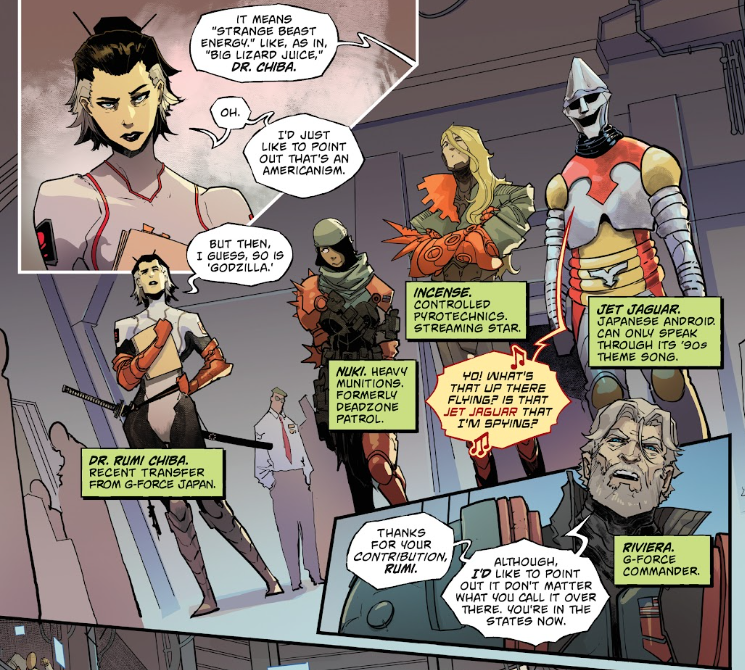
The first scene of the comic is a monologue describing how much like the 1954 movie Godzilla came out of the sea and destroyed Tokyo. However unlike the ending of that movie where Godzilla is successfully killed thanks to Dr. Serizawa there was no solution here. Godzilla just left and kept coming back. And well, since this is an American comic Godzilla is not just content with Japan, he also takes chunks out of America. As the explanation continues the person giving the monologue, Captain Rivera of the G-force unit in America, explains that Kai Sei Energy translates to Strange Beast Energy. A new recruit to G-Force USA, a Dr. Rumi Chiba, clarifies that that’s an Americanism. Though she quickly gives up any fight this may have led to by conceding that Godzilla is an Americanism too. This perfectly sets up the conflict at the heart of the book, at least the political one. It’s very much an examination of the mindset of America as a whole. Particularly how quick the countries leaders (And some of its citizens) are to place all anger and dreams of revenge on anything but themselves. Specifically it’s a look at America’s post 9/11 response. Yes lives were lost but America uses it to capitalize on it’s own bloodlust rather than actually trying to stop the violence. A contrast to what Dr. Rumi at least claims is Japan’s way, which is understanding with the monsters, to treat them more like natural disasters rather than something to project rage and anger onto. This ties back to Ishiro Honda’s philosophy when it comes to Kaiju, that there should be some amount of understanding and pity.
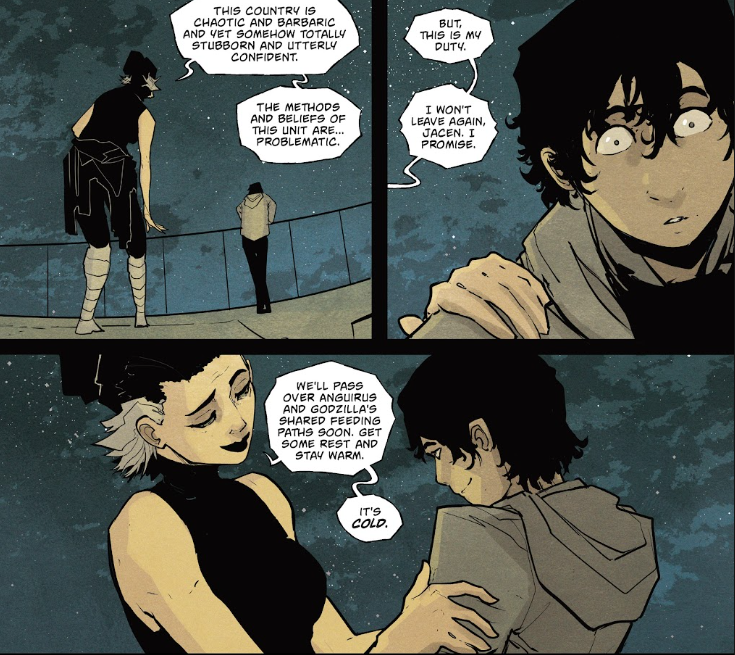
The first scene of the book continues to show footage of a boy who is blasted by Godzilla and instead of dying is able to absorb the beast’s energy and use it to power himself up full on anime style. This boy is called Jacen and he is the true protagonist of the book (Though within the first 6 issue arc I’m discussing here it can be argued and him and Rumi are Deuteroganists) and his journey of a more personal anger he deals with (His father dying of cancer and his mother being killed by Godzilla when he was young leaving him an orphan for most of his life will do that) perfectly compliments the larger story of America’s anger by making his a story of who and what we place our faith in when anger takes over. Who do we listen to, who are we loyal to when you’re not able to think decisions through? Very early on Jacen and Dr. Rumi form a sweet relationship with her being a much needed mother figure in his life. She teaches him about Japan’s way of dealing with the monsters and generally trying to help him get some sort of grounding as opposed to Captain Rivera mostly wanting to use him as a weapon.
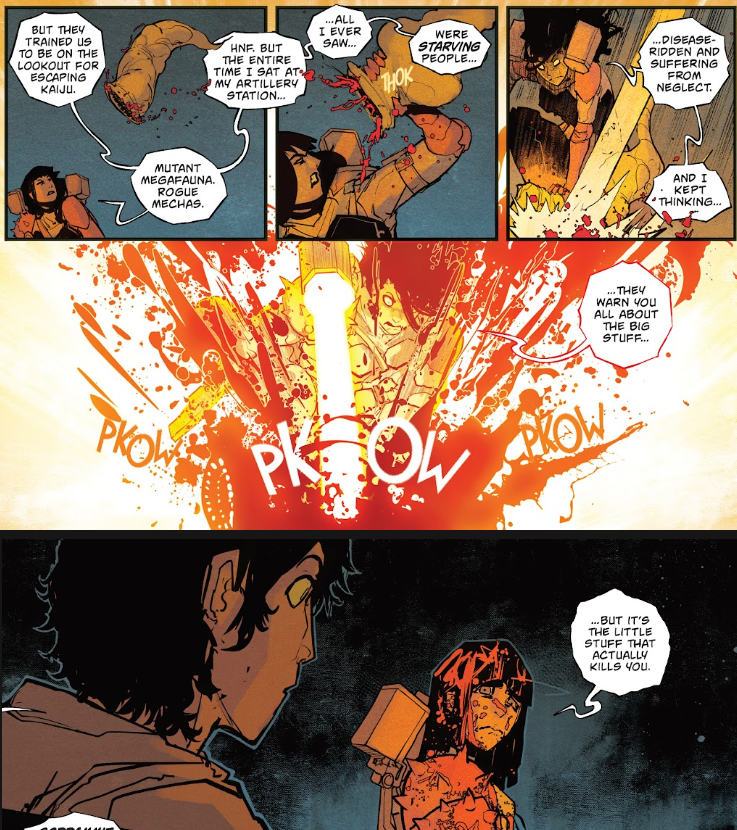
There’s so many scenes in the first arc that illustrate America’s reactions to the threat of Godzilla and the hole that his attacks have left in the country (almost literally, with a section of the USA being titled The Deadzone because it’s an irradiated wasteland). One of Jacen’s teammates talks about her time there, how she was trained to look out for Kaiju and mutants trying to escape and all she ever saw was people starving and mutated. The big stuff doesn’t kill you, it’s the small stuff. The American government has spent more money to kill Godzilla than to help it’s citizens. This is also established by a scene in issue 3 where a random company tries to send out it’s own home made robot to fight godzilla while advertising it’s product. There are few people who could maybe make a difference about this to actually care. It’s all about developing new weapons and stoking the fires of perpetual anger.
Nowhere is this more clearly stated than in the character of Lament, who brings some of these disparate ideas together. At the end of the first issue we see the silhouette of a giant kaiju, one that can talk and who clearly has nefarious plans. In issue 2 we learn about leeches that are super effective against Godzilla and the other Kaiju. By Issue 4 we learn that these were created by someone and that someone was Lament. Lament wants Godzilla dead at all costs. So does G-Force USA, so the bulk of the group (Minus Jacen and Dr. Rumi who are off doing other things) end up teaming up with Lament at first. Once Rumi and Jacen come back they knock some sense into their other team members. With Lament revealing that yeah, it was manipulating them mostly. But it really does want Godzilla dead. It wants Godzilla dead because it took her life from her. An attack by Godzilla when she was trying to study Kai-Sei energy to potentially get rid of her cancer (The same cancer that took her husband) left her damaged and mutated. She’s spent the rest of her time trying to kill Godzilla. This is the same attack that took away Jacen’s mother…Lament IS Jacen’s mother. This is enough for Jacen to fall back on old habits, forgetting everything Rumi tried to teach him and launch into a rage against Godzilla.
Lament is a perfect representation of America post 9/11. The loss might have been real, but it was spurred on by previous actions and was immediately used to justify actions going forward. Lament even expected Jacen’s reaction, for him to fight on her behalf purely out of loyalty and an anger that’s been stoked in him all his life. The exact same way the American Government (Both sides of the aisle) will never truly cut out its racist rhetoric and then falls back on it whenever it wants a country terrorized and mined for resources, expecting it’s citizens to fall for it.
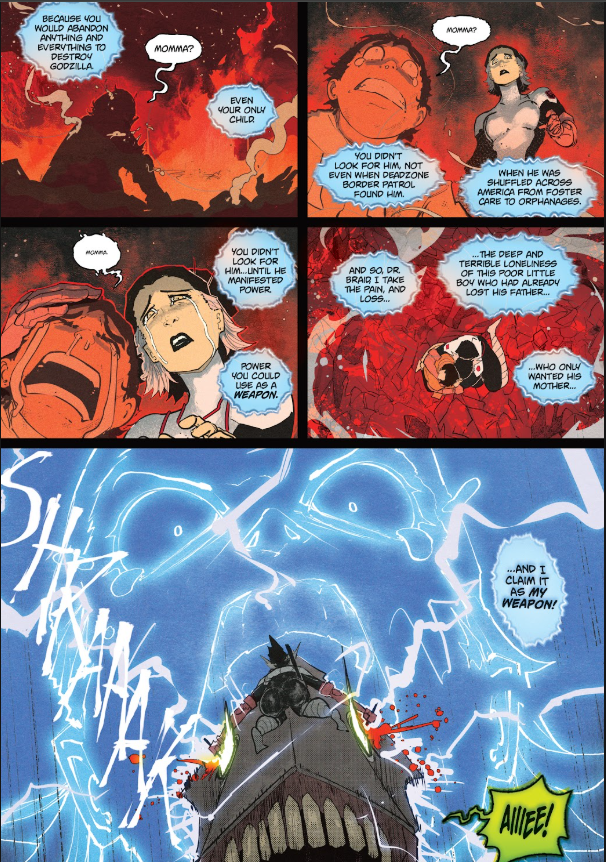
Dr. Rumi, continuing to be the mom who stepped the hell up cuts through all the bullshit in an incredible scene, my favorite in the book and is maybe my favorite page of the year so far. She points out that Jacen’s mother could’ve went to him even as mutated as she was, but she didn’t. She abandoned her son for revenge and only sought him out once she realized he could be useful. The same way that America always looks for ways to villanize others and use any opportunity to play the victim even when they’re the aggressors.
The ending of the arc is Godzilla dying and Jacen absorbing his essence, with Jacen actually managing to kill him. While it’s obvious where this is going for Jacen’s personal journey, it’s hard to know how this will affect the political commentary going forward, as we’re only one issue into the new arc as of the time of me writing this. But in short this has so far been an absolute stand out book that even in a time in mainstream comics where we’re reaching critical mass of leftist messaging in comics (With not everyone doing it well) Godzilla is given a new lease on life in America by making it relevant to our struggles here in America the way Godzilla always reflects the inner strife of the Japanese.
Hope ya liked this, as I said we’re really in a golden age of comics of all kinds dealing with leftist American commentary so I’ll probably be doing a lot of analysis like this about some of my favorites.
"I came to this country an outcast and an outsider, charged with helping a broken land regain it's soul. Here, I have seen cruelty. I have seen barbarity. I have seen ignorance and arrogance paraded as patriotism. But in Jacen Braid, an orphan child as lost in Godzilla's world as America itself, who absorbed the vengeful energy of the King of the Monsters, I saw something else. I saw selflessness. I saw sacrifice. I saw change and growth. I saw hope." - Godzilla (2025) #6
Earlier last year Comic Company IDW, who had held the Godzilla comic license since 2011 had decided that for the first time since 2015 to create a shared universe for the Big G again. Long ongoing comics all set in the same continuity instead of a bunch of one shots and mini-series. There are three books in this new line, titled The Kai-Sei Universe, so far. However for the purpose of this I will only be talking about the flagship book of the line, just titled Godzilla. However first I think retracing the origin of the Godzilla concept and it's cultural impact is important whenever talking about the franchise.
The year was 1954, just 9 years after America dropped the atomic bomb on Hiroshima and Nagasaki. A cruel and unforgivable war crime, regardless of how America did and continues to dress up it's evil as necessary. Movie studio Toho was in negotiations with an Indonesian film company to create a movie together, a negotiation which would fall apart. It would stand to reason that part of why this happened is because of tensions between the two nations due to Japan's own horrific actions in World War 2, an evil it also ignores, but I digress. The producer of that never to be made film let his mind wander on the trip back home, inspired partially by the Castle Bravo test that America did. The Castle Bravo test being a nuclear test that ended up with more yield than they expected, radiating outside of the safe perimeter they had established and ended up radiating a japanese fishing boat, the Lucky Dragon No. 5. He ended up thinking about what larger horrors a weapon like the nuclear bomb could create. The first seeds of the King of the Monsters had been established, now it needed someone to help it take shape.
Enter Ishiro Honda. A man who through being repeatedly drafted and recalled was on the frontlines for basically all 6 years of World War 2. To be transparent I was going to go into some specifics of his time in the military but truly it’s not necessary and his life is so interesting that it’d do a disservice to try to sum it up as part of another essay. The point is that during his time directing he was very conscious of injecting a reflection of what Japan’s political climate. This means every Godzilla movie directed by him tackled something slightly different culturally and thus established Godzilla as not just the Nuclear War metaphor he was conceived as but an infinitely flexible character who can represent any struggle Japan is dealing with, or a hero that can save them from those struggles.
It wouldn’t exactly be revolutionary to point out that the American adaptations of the franchise tend to shy away from deeper political implications, so I won’t belabor the point. That being said, I do enjoy the Monsterverse as punch ‘em up flicks and it’s not like IDW’s previous efforts haven’t had a lot of success of being able to more properly embody the kinds of stories the best Godzilla movies tell. Half Century War for instance is an absolute classic. But the vast majority of American made Godzilla adaptations are spectacle first with not much coming second.
Enter Tim Seeley who…to be honest is just kind of a white guy. He’s written some good comics and he’s written some bad comics. A pretty mixed bag of a writer overall. He’s not exactly a revolutionary…but god damn does he understand how to use Godzilla as more than just a monster.
The first scene of the comic is a monologue describing how much like the 1954 movie Godzilla came out of the sea and destroyed Tokyo. However unlike the ending of that movie where Godzilla is successfully killed thanks to Dr. Serizawa there was no solution here. Godzilla just left and kept coming back. And well, since this is an American comic Godzilla is not just content with Japan, he also takes chunks out of America. As the explanation continues the person giving the monologue, Captain Rivera of the G-force unit in America, explains that Kai Sei Energy translates to Strange Beast Energy. A new recruit to G-Force USA, a Dr. Rumi Chiba, clarifies that that’s an Americanism. Though she quickly gives up any fight this may have led to by conceding that Godzilla is an Americanism too. This perfectly sets up the conflict at the heart of the book, at least the political one. It’s very much an examination of the mindset of America as a whole. Particularly how quick the countries leaders (And some of its citizens) are to place all anger and dreams of revenge on anything but themselves. Specifically it’s a look at America’s post 9/11 response. Yes lives were lost but America uses it to capitalize on it’s own bloodlust rather than actually trying to stop the violence. A contrast to what Dr. Rumi at least claims is Japan’s way, which is understanding with the monsters, to treat them more like natural disasters rather than something to project rage and anger onto. This ties back to Ishiro Honda’s philosophy when it comes to Kaiju, that there should be some amount of understanding and pity.
The first scene of the book continues to show footage of a boy who is blasted by Godzilla and instead of dying is able to absorb the beast’s energy and use it to power himself up full on anime style. This boy is called Jacen and he is the true protagonist of the book (Though within the first 6 issue arc I’m discussing here it can be argued and him and Rumi are Deuteroganists) and his journey of a more personal anger he deals with (His father dying of cancer and his mother being killed by Godzilla when he was young leaving him an orphan for most of his life will do that) perfectly compliments the larger story of America’s anger by making his a story of who and what we place our faith in when anger takes over. Who do we listen to, who are we loyal to when you’re not able to think decisions through? Very early on Jacen and Dr. Rumi form a sweet relationship with her being a much needed mother figure in his life. She teaches him about Japan’s way of dealing with the monsters and generally trying to help him get some sort of grounding as opposed to Captain Rivera mostly wanting to use him as a weapon.
There’s so many scenes in the first arc that illustrate America’s reactions to the threat of Godzilla and the hole that his attacks have left in the country (almost literally, with a section of the USA being titled The Deadzone because it’s an irradiated wasteland). One of Jacen’s teammates talks about her time there, how she was trained to look out for Kaiju and mutants trying to escape and all she ever saw was people starving and mutated. The big stuff doesn’t kill you, it’s the small stuff. The American government has spent more money to kill Godzilla than to help it’s citizens. This is also established by a scene in issue 3 where a random company tries to send out it’s own home made robot to fight godzilla while advertising it’s product. There are few people who could maybe make a difference about this to actually care. It’s all about developing new weapons and stoking the fires of perpetual anger.
Nowhere is this more clearly stated than in the character of Lament, who brings some of these disparate ideas together. At the end of the first issue we see the silhouette of a giant kaiju, one that can talk and who clearly has nefarious plans. In issue 2 we learn about leeches that are super effective against Godzilla and the other Kaiju. By Issue 4 we learn that these were created by someone and that someone was Lament. Lament wants Godzilla dead at all costs. So does G-Force USA, so the bulk of the group (Minus Jacen and Dr. Rumi who are off doing other things) end up teaming up with Lament at first. Once Rumi and Jacen come back they knock some sense into their other team members. With Lament revealing that yeah, it was manipulating them mostly. But it really does want Godzilla dead. It wants Godzilla dead because it took her life from her. An attack by Godzilla when she was trying to study Kai-Sei energy to potentially get rid of her cancer (The same cancer that took her husband) left her damaged and mutated. She’s spent the rest of her time trying to kill Godzilla. This is the same attack that took away Jacen’s mother…Lament IS Jacen’s mother. This is enough for Jacen to fall back on old habits, forgetting everything Rumi tried to teach him and launch into a rage against Godzilla.
Lament is a perfect representation of America post 9/11. The loss might have been real, but it was spurred on by previous actions and was immediately used to justify actions going forward. Lament even expected Jacen’s reaction, for him to fight on her behalf purely out of loyalty and an anger that’s been stoked in him all his life. The exact same way the American Government (Both sides of the aisle) will never truly cut out its racist rhetoric and then falls back on it whenever it wants a country terrorized and mined for resources, expecting it’s citizens to fall for it.
Dr. Rumi, continuing to be the mom who stepped the hell up cuts through all the bullshit in an incredible scene, my favorite in the book and is maybe my favorite page of the year so far. She points out that Jacen’s mother could’ve went to him even as mutated as she was, but she didn’t. She abandoned her son for revenge and only sought him out once she realized he could be useful. The same way that America always looks for ways to villanize others and use any opportunity to play the victim even when they’re the aggressors.
The ending of the arc is Godzilla dying and Jacen absorbing his essence, with Jacen actually managing to kill him. While it’s obvious where this is going for Jacen’s personal journey, it’s hard to know how this will affect the political commentary going forward, as we’re only one issue into the new arc as of the time of me writing this. But in short this has so far been an absolute stand out book that even in a time in mainstream comics where we’re reaching critical mass of leftist messaging in comics (With not everyone doing it well) Godzilla is given a new lease on life in America by making it relevant to our struggles here in America the way Godzilla always reflects the inner strife of the Japanese.
Hope ya liked this, as I said we’re really in a golden age of comics of all kinds dealing with leftist American commentary so I’ll probably be doing a lot of analysis like this about some of my favorites.
"I came to this country an outcast and an outsider, charged with helping a broken land regain it's soul. Here, I have seen cruelty. I have seen barbarity. I have seen ignorance and arrogance paraded as patriotism. But in Jacen Braid, an orphan child as lost in Godzilla's world as America itself, who absorbed the vengeful energy of the King of the Monsters, I saw something else. I saw selflessness. I saw sacrifice. I saw change and growth. I saw hope." - Godzilla (2025) #6


no subject
Date: 2026-02-28 05:51 pm (UTC)